
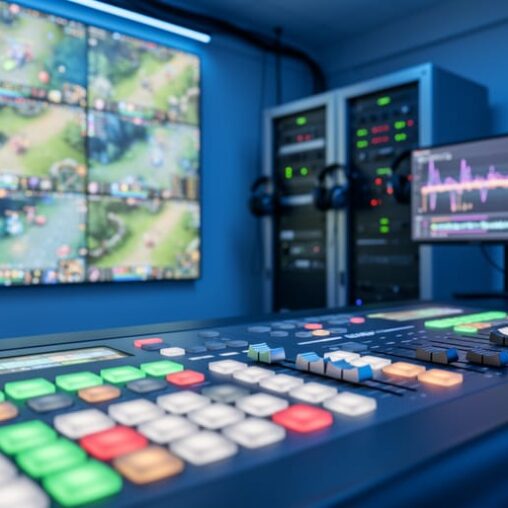
Production broadcast is the process of capturing, mixing, and transmitting live gameplay footage with professional overlays, commentary, and camera feeds to deliver a polished viewing experience for online and in-venue audiences. In the esports world, it’s what transforms a simple game stream into an event that rivals traditional sports coverage, complete with instant replays, player cameras, live statistics, and seamless transitions between matches.
The difference between a basic stream and production broadcast is night and day. A standard stream might show gameplay with a webcam and basic audio. Production broadcast integrates multiple video sources, broadcast-quality graphics, dedicated camera operators, audio mixing boards, and specialized software that manages everything in real time. When you watch a major esports tournament and see the smooth cuts between casters at the desk, the live scoreboard updating on screen, and perfectly timed replays of clutch moments, you’re seeing production broadcast in action.
For event organizers, understanding production broadcast capabilities is essential. The technology impacts everything from venue setup requirements to streaming platform compatibility, and the quality directly affects viewer retention and sponsor visibility. Whether you’re planning a 50-person local tournament or a multi-day championship, the broadcast production setup determines how your event reaches and engages its audience.
This guide breaks down how production broadcast works from signal capture to final output, explores the key components that create broadcast-quality esports content, and shows you how different production setups match different event scales and budgets. You’ll learn what separates amateur streams from professional broadcasts and how to evaluate what your next event actually needs.
What Production Broadcast Means for Esports Events
Production broadcast for esports events is the end-to-end technical process that captures raw gameplay from consoles like Xbox, PlayStation 4, and Nintendo Switch, then layers in visual polish, audio clarity, and professional production elements before delivering the final stream to viewers. It’s fundamentally different from someone just hitting “Go Live” on a basic streaming setup. Where casual streaming typically shows a single gameplay feed with maybe a webcam in the corner, production broadcast orchestrates multiple video sources, manages live graphics overlays, balances audio from players and commentators, and switches between camera angles to create a cohesive viewing experience that rivals traditional sports coverage.
The workflow starts with capture equipment pulling video and audio directly from gaming consoles, similar to how you’d connect for remote play vs cloud gaming but with broadcast-grade hardware instead of consumer devices. From there, a production team actively manages what viewers see moment-to-moment: switching to the most exciting player perspective during intense firefights, bringing up live score tickers when matches conclude, and cutting to facial cams when competitors react to clutch plays. This real-time decision-making separates professional broadcasts from static, single-view streams.
The payoff shows up in viewer retention and event legitimacy. A well-executed production broadcast makes your esports event feel like a major competition worth watching, not just someone’s gaming session that happens to be online. Spectators stay engaged because the broadcast anticipates what they want to see, when they want to see it, with the visual clarity and information density that makes competitive gaming genuinely entertaining to watch.
How Production Broadcast Works: The Technical Pipeline
Capture and Input Sources
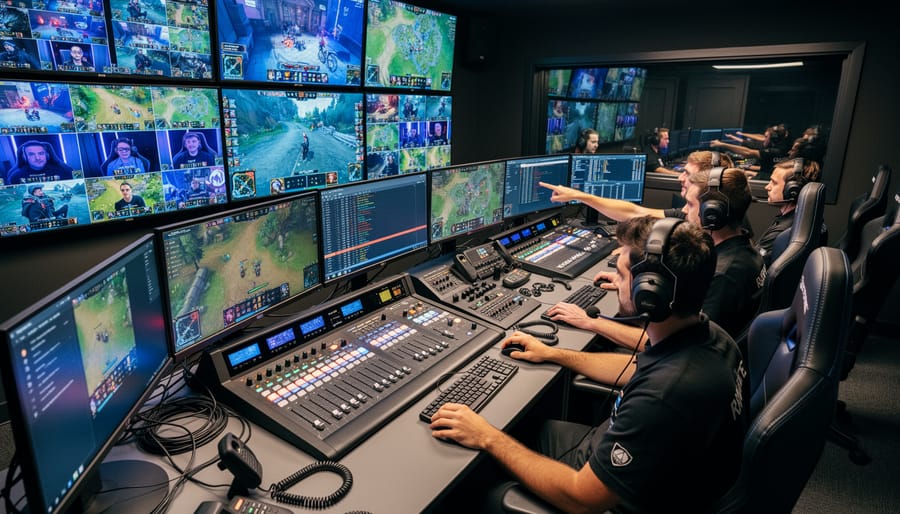
Every professional esports broadcast starts with clean signal capture from the source. Modern tournaments pull feeds from multiple gaming consoles, Xbox Series X, PlayStation 5, Nintendo Switch, running simultaneously, each outputting HDMI signals to a central video switcher. The broadcast equipment setup includes capture cards that convert these HDMI outputs into digital streams the production team can manipulate in real time.
Facial cameras mounted above or beside each gaming station feed directly into the same system, tracking player reactions during clutch moments and tournament-deciding plays. USB webcams work for smaller events, while larger productions use dedicated PTZ cameras for sharper image quality and remote control capabilities.
Audio capture runs parallel: game sound comes through the console outputs, player communication through dedicated microphones, and crowd noise through ambient mics placed strategically around the venue. Each audio source arrives as a separate channel at the mixing desk, allowing precise control over what viewers hear and at what volume. This multi-source approach transforms chaotic gaming sessions into clean, professional viewing experiences.
Mixing and Switching
The heart of production broadcast happens at the switcher, where a director or technical operator makes real-time decisions about what viewers see. During a match, they’re constantly evaluating which player’s perspective tells the best story, switching to the player making a crucial play, showing a defensive setup, or capturing the moment before a game-winning elimination.
Modern video switchers allow seamless transitions between multiple sources. You can cut between player 1’s screen and player 2’s screen, bring up a facial cam in picture-in-picture mode, or switch to a wide shot of the entire tournament bracket. The goal is keeping viewers engaged by showing them the most relevant action at any given moment.
Graphics overlay happens simultaneously during this mixing process. Live tickers display updated scores, countdown timers build tension before match starts, and lower thirds identify players or teams. These elements aren’t added in post-production, they’re composited live as part of the broadcast feed, which means what viewers see on Twitch or YouTube is the finished product in real time.
The skill lies in anticipating the action. A good production operator knows when to switch cameras before the play happens, creating a viewing experience that feels intentional rather than reactive.
Encoding and Distribution
Once the production team has mixed all the feeds into a cohesive broadcast, the next challenge is getting that content to viewers without breaking the internet connection or sacrificing visual quality. This is where encoding and distribution come into play.
Encoding compresses the raw video signal into manageable file sizes. Modern esports broadcasts typically use codecs like H.265 for low bandwidth environments or H.264 for broader compatibility. The encoder balances three competing priorities: video quality (resolution and frame rate), file size (how much data the stream requires), and latency (the delay between live action and viewer screens). Esports demands particularly high frame rates since fast-paced gameplay at 30fps looks choppy compared to 60fps, but doubling the frame rate roughly doubles the bandwidth requirements.
Distribution platforms receive the encoded stream and deliver it to audiences. Common destinations include:
- Twitch for gaming-focused audiences with low-latency options
- YouTube Live for broader reach and better discoverability
- Facebook Gaming for community-integrated events
- Private CDNs for corporate or campus-only broadcasts
- Multi-platform simultaneous streaming for maximum exposure
Professional setups often stream to multiple platforms simultaneously, using restreaming services that duplicate the feed without requiring separate encoders for each destination. The broadcast quality settings depend on your upload bandwidth and target audience, with 1080p at 60fps becoming the standard for competitive esports in 2026 while 4K remains reserved for major tournaments with robust internet infrastructure.
Core Broadcast Production Features That Elevate Events
Live Tickers and On-Screen Graphics
Real-time graphics keep viewers locked into the action by answering the questions that pop up during competitive play: Who’s winning? How many rounds left? What’s the overall tournament standing? Live tickers display scores that update instantly as points are earned, eliminating confusion about match progression. They sit cleanly at screen edges or corners, providing constant reference without blocking crucial gameplay.
Tournament brackets appear during breaks or picture-in-picture during matches, showing viewers where the current game fits into the larger competition. Player stats, K/D ratios, damage dealt, objectives captured, add analytical depth that transforms casual watching into informed viewing. These graphics highlight individual performances and create storylines beyond the final score.
The best on-screen packages balance information density with visual restraint. Overwhelming viewers with cluttered displays diminishes the gameplay itself, while too little information leaves audiences disoriented. Professional broadcast setups allow operators to call up specific graphics on demand: pulling up head-to-head records before a rivalry match or displaying sponsor logos during natural pauses. This flexibility makes broadcasts feel polished and intentional rather than generic.
Multi-Camera and Facial Cam Integration
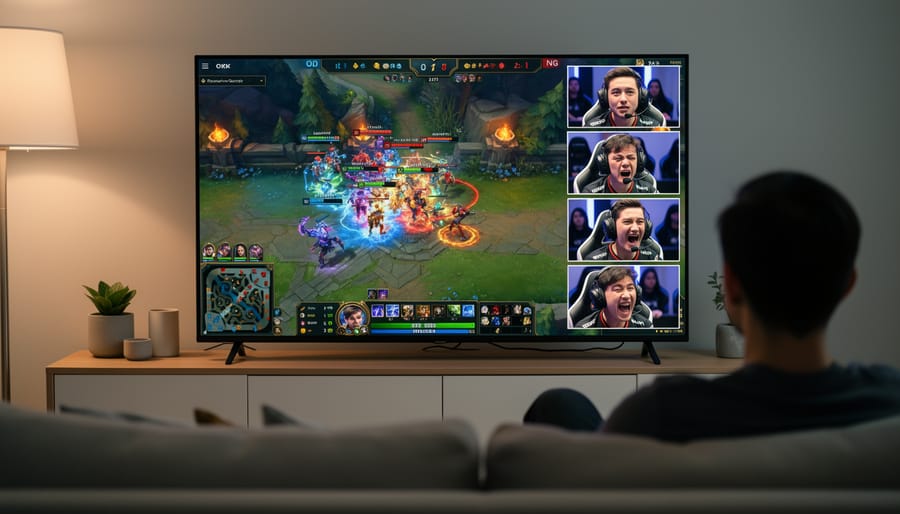
Participant reactions often matter as much as the gameplay itself. Multi-camera setups let production teams capture facial expressions, body language, and immediate emotional responses as critical plays unfold. When a player clutches a round or misses a game-winning shot, viewers see the genuine human moment, the fist pump, the head shake, the focused intensity.
Facial cam feeds integrate directly into the broadcast overlay, typically positioned in corners or side panels alongside the main gameplay view. This simultaneous perspective transforms abstract competition into relatable drama. Viewers connect with competitors as people, not just usernames on a scoreboard.
For team-based esports, multi-camera production switches between individual player perspectives and wide shots showing the entire roster’s synchronized reactions. During tense moments, cutting to a close-up of a competitor’s concentration or celebration amplifies the emotional stakes.
The technical setup requires dedicated cameras for each featured participant, proper lighting to avoid shadows or glare, and synchronized feeds that align perfectly with gameplay timing. When executed well, facial cam integration turns competitive gaming into compelling human storytelling that keeps audiences invested beyond the mechanics.
Audio Production and Commentary
Audio quality separates amateur streams from professional broadcasts. Clean game audio starts with proper level balancing, keeping gunshots, ability effects, and environmental sounds crisp without overwhelming dialogue. Production teams isolate game audio feeds from player communication channels, preventing Discord chatter or team callouts from bleeding into the viewer experience.
Microphone mixing for players requires individual channel control. Each competitor needs independent volume adjustment to ensure clear callouts during team play while maintaining intelligible commentary overlay. Proper mic technique and pop filters eliminate distracting plosives and background noise that break viewer immersion.
Commentary desk integration brings sports broadcast polish to gaming tournaments. Two-person commentary teams, typically one play-by-play announcer and one analyst, provide context and excitement that raw gameplay lacks. Commentary examples from established esports leagues demonstrate how dynamic casting elevates tension during clutch moments. TV-style esports commentary requires dedicated audio routing so casters hear game sound and producer communication through headphones while their voices mix cleanly into the broadcast feed without feedback loops.
Instant Replay and Highlight Systems
During intense matches, the ability to instantly revisit crucial moments separates amateur streams from professional productions. Instant replay systems capture gameplay continuously, letting production teams queue and display highlights within seconds of spectacular plays occurring.
Modern broadcast setups use dedicated replay software that buffers recent gameplay, enabling operators to mark significant moments, an unexpected comeback, a perfectly executed strategy, or a game-winning play. These clips can be triggered immediately or saved for transition breaks, maintaining broadcast momentum while giving viewers another perspective on what just happened.
Replay functionality serves multiple purposes beyond entertainment. Commentary teams use slow-motion replays to break down tactical decisions, explaining why a particular approach succeeded or failed. This analysis adds educational value for viewers while filling natural pauses between rounds or matches.
The highlight compilation extends beyond live events too. Production teams often create post-event recap packages from the same captured moments, delivering promotional content that attracts future participants and builds anticipation for subsequent tournaments.
Where Production Broadcast Makes the Biggest Impact
Campus Esports and Educational Tournaments
Campus esports programs have exploded across North America, with over 300 Canadian post-secondary institutions now running competitive gaming initiatives. Production broadcast transforms these tournaments from casual dorm room sessions into credible athletic events that administrators and sponsors take seriously.
When universities stream their League of Legends or Valorant tournaments with professional graphics, commentary desks, and player cams, they signal that esports deserves the same investment as traditional sports. This legitimacy attracts top-tier talent during recruitment, increases spectator engagement both on-campus and online, and creates content that alumni associations can share. Schools report 40% higher tournament registration when events feature broadcast-quality production compared to basic Twitch streams, proving that professional presentation directly drives participation and builds program credibility.
Corporate and Brand Activation Events
Corporate brand activations demand presentation quality that matches their marketing investment, and production broadcast delivers exactly that polish. When a company sponsors a gaming tournament or hosts a product launch with an esports component, they’re not just buying screen time, they’re buying perception. Professional broadcast features transform what could look like kids playing video games into legitimate, premium entertainment that justifies marketing budgets and impresses stakeholders.
The live tickers displaying sponsor logos alongside match statistics create constant brand visibility without feeling intrusive. Facial cams capture authentic participant reactions that make for shareable social content, extending campaign reach beyond the live event. Clean audio mixing ensures product mentions and branded commentary come through clearly, while instant replay systems let production teams highlight sponsor-branded moments multiple times throughout the broadcast.
For brands testing the esports waters, broadcast quality often determines whether they view gaming as a viable marketing channel or a risky experiment. A polished production proves gaming events can deliver the same professional presentation standards as traditional sports sponsorships.
Public Gaming Kiosks and Venue Displays
Walking through a gaming venue should feel electric, and broadcast production features turn passive foot traffic into crowds gathered around screens. When production broadcasts stream live from gaming kiosks to overhead displays, casual passersby become invested spectators watching player reactions through facial cams and following match progression on live scoreboards.
Retail gaming lounges and entertainment venues use broadcast-quality displays to showcase what’s happening at their stations in real time. The difference between showing raw gameplay versus a produced feed with player perspectives, score tickers, and instant replays is enormous, viewers immediately understand what they’re watching and who’s winning.
Shopping mall activations and convention floor setups benefit particularly from this approach. A well-produced broadcast running on large displays creates natural gathering points where people stop, watch a few minutes of competition, then decide to participate themselves. The production value signals that something worth watching is happening, transforming gaming from a solitary activity into spectator entertainment that drives participation and extends dwell time at venues.
Common Questions About Esports Production Broadcasts
Production broadcast setups raise practical questions for anyone organizing gaming events. Understanding the technical requirements, skill demands, and scalability helps event planners make informed decisions about their broadcast capabilities.
What equipment do I need for a basic production broadcast?
A functional setup requires capture cards for each gaming station, a video switcher or mixing software, a streaming-capable computer, quality microphones, and internet bandwidth of at least 10 Mbps upload. Professional setups add dedicated cameras, lighting, and hardware encoders.
Do I need a professional operator to run the broadcast?
Entry-level software switchers can be learned in a few hours, making basic broadcasts accessible to motivated volunteers. Complex multi-camera productions with live graphics benefit from experienced operators who can handle simultaneous feed management and real-time decision making.
How much latency should I expect between gameplay and stream?
Standard streaming platforms introduce 10-30 seconds of delay, which works fine for most events. Low-latency modes reduce this to 3-5 seconds but require more bandwidth and processing power.
Can production broadcast scale from small events to large tournaments?
The core workflow remains consistent across event sizes. Small gatherings might use a single laptop and basic software, while major tournaments add specialized hardware, multiple operators, and dedicated production rooms, but the fundamental capture-mix-distribute pipeline stays the same.
Platform compatibility deserves special attention since esports events often feature multiple gaming systems. Modern capture solutions handle Xbox, PlayStation, Nintendo Switch, and PC simultaneously, letting production teams switch between different games without technical interruptions. This flexibility proves crucial for multi-title tournaments where competitors move between fighting games on one console and shooters on another.
The real barrier isn’t technical complexity, it’s understanding what level of production matches your event goals. A university league might thrive with student operators and consumer-grade equipment, creating valuable learning experiences while delivering broadcasts that satisfy participants and spectators. Corporate showcases demand polished presentations that reflect brand standards, justifying investment in professional gear and experienced crew. The broadcast quality should serve the event’s purpose rather than chase an arbitrary standard of sophistication.
Production broadcast has become the defining factor that separates forgettable gaming sessions from events that audiences remember and share. The technical workflow we’ve explored, from multi-source capture through live mixing to polished distribution, isn’t reserved for major league championships anymore. In 2026’s competitive esports landscape, even campus tournaments and corporate activations benefit from the legitimacy and excitement that professional broadcast features deliver.
The beauty of modern production broadcasting lies in its scalability. Whether you’re running a weekend Nintendo Switch tournament at a college or hosting a multi-day corporate gaming activation, the core elements remain accessible: clean video switching, participant facial cams capturing authentic reactions, live tickers keeping spectators engaged, and quality audio that makes every moment feel significant. These features don’t just improve what viewers see, they fundamentally change how audiences connect with the competition.
For event organizers, the investment in broadcast production features pays dividends beyond the live stream itself. Recorded content becomes promotional material for future events. Sponsors see their brands associated with polished, professional entertainment rather than amateur gameplay. Participants feel the weight and prestige of competing in a legitimate production, which elevates their performance and commitment.
The question isn’t whether your gaming event needs production broadcast capabilities, it’s how quickly you can implement them before your competition does. The technology exists, the audience expects it, and the impact on event success is undeniable.