
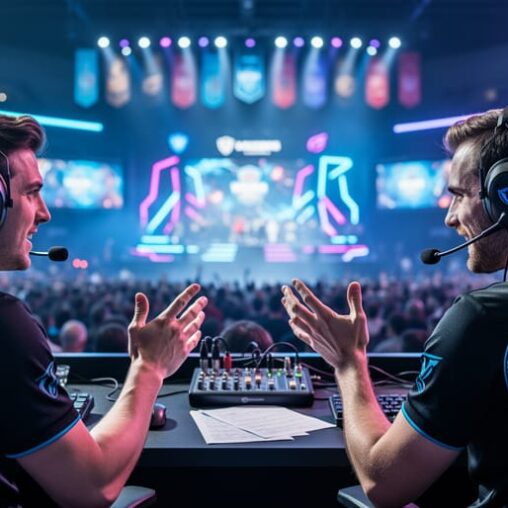
Great esports commentary transforms a competitive match from a confusing blur of action into a gripping narrative that keeps viewers glued to their screens. When you’re searching for commentary examples, you need more than generic descriptions. You need real samples that show exactly how professional shoutcasters build hype during clutch moments, explain complex strategies without losing casual viewers, and maintain energy through marathon tournament broadcasts.
Professional commentary exists on a spectrum. Play-by-play announcers deliver rapid-fire action calls that capture every headshot, ability rotation, and objective push as they happen. Color commentators dive deeper, breaking down team compositions, reading win conditions, and predicting strategic pivots before they unfold. The best broadcasts blend both styles seamlessly, creating an experience that educates newcomers while satisfying veterans who catch every subtle outplay.
The difference between amateur and professional commentary becomes crystal clear when you compare side-by-side examples. Amateur casters often fall into dead air during farming phases or resort to repetitive phrases that drain excitement from pivotal plays. Professional commentators fill those quieter moments with storyline development, player background insights, and strategic setup that makes the next team fight even more impactful.
Understanding these examples helps you recognize quality when booking talent for your event or developing your own casting skills. From solo streams requiring one versatile voice to multi-stage tournaments demanding coordinated analyst desks, each format requires different approaches. The samples and breakdowns that follow give you concrete reference points for what exceptional esports commentary actually sounds like in practice.
What Makes Great Esports Commentary
Great esports commentary transforms passive viewers into engaged participants who feel every clutch play and strategic decision. Unlike casual streaming where entertainers focus on their own reactions, professional commentary serves the audience first, delivering a structured narrative that makes complex gameplay accessible while maintaining competitive intensity.
Professional commentators distinguish themselves through three interconnected pillars: technical expertise, adaptive energy management, and audience-focused delivery. Technical expertise means understanding game mechanics deeply enough to explain split-second decisions without halting the action’s flow. When a Counter-Strike player executes a perfectly-timed flash peek, strong commentary identifies the setup and execution instantly, educating viewers while the round continues. This knowledge base separates qualified commentators from skilled players who struggle to articulate what they instinctively understand.
Energy management creates the commentary’s emotional architecture. Professional commentators calibrate their intensity to match game state, building from measured analysis during setup phases to explosive excitement during decisive team fights. They avoid monotone delivery that flattens dramatic moments and prevent exhausting audiences with constant shouting that makes everything feel equally important. This dynamic pacing keeps viewers invested through hour-long broadcasts.
The essential characteristics of effective esports commentary include:
- Precise vocabulary that describes actions clearly without unnecessary filler words
- Strategic foreshadowing that hints at developing plays before they execute
- Technical awareness of production elements like replays and stat overlays
- Adaptability to shift between play-by-play intensity and analytical depth
- Inclusive language that welcomes new viewers without alienating dedicated fans
Professional commentary matters for event success because it directly impacts viewer retention and sponsor value. Broadcasts with polished commentary maintain higher engagement metrics across extended tournaments, making them more attractive for brand partnerships. For corporate and campus events, quality commentary elevates perceived production value and legitimizes competitive gaming. Given the esports viewership comparison to traditional sports audiences, professional standards become essential for credibility. Strong commentary transforms a series of matches into a cohesive broadcast experience worth watching from start to finish.
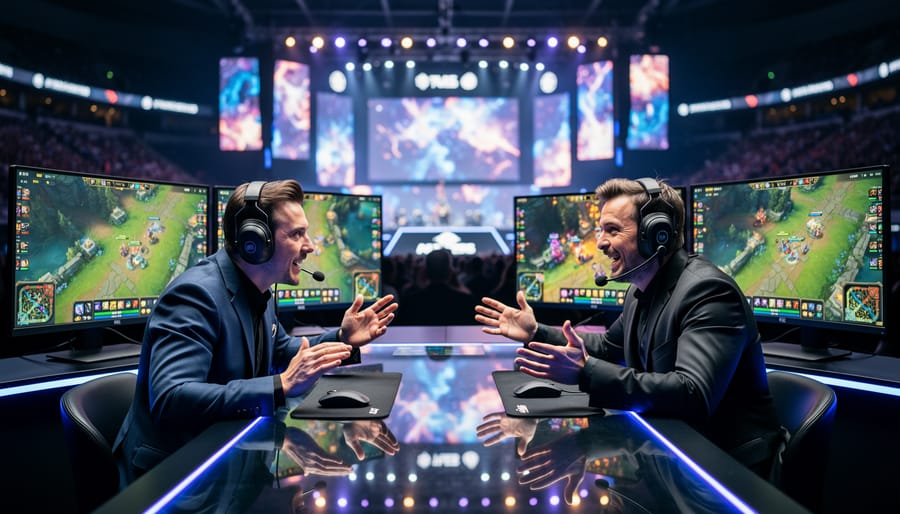
Play-by-Play Commentary Examples
FPS Game Commentary Style
FPS commentary demands split-second reactions and spatial awareness that mirrors the gameplay itself. A Counter-Strike commentator might call: “NiKo’s holding banana with the AWP, two coming through, there’s the peek, he misses! Falling back to sandbags, molly coming in, he’s trapped!” Notice how each phrase advances the action while providing location context that helps viewers follow the chaos.
Valorant commentary layers agent abilities into the mix: “Jett’s dashing onto site, smokes are down, but here comes the Sova dart, she’s revealed! Phoenix is swinging wide right, there’s the flash, two frags, THE ACE IS ON!” The rhythm accelerates with the action, punctuated by brief pauses that let big plays breathe.
Tactical callouts separate amateur coverage from professional broadcasts. Instead of “they’re fighting over there,” effective FPS commentary specifies: “Three holding long A, utility’s been burned, this execute needs to happen in the next fifteen seconds or they lose map control entirely.” This precision helps viewers understand not just what’s happening, but why it matters for round outcomes and overall match strategy.
Fighting Game Commentary Approach
Fighting games demand a unique commentary rhythm that mirrors the split-second decisions happening on screen. When a player lands a complex combo, the commentator breaks it down: “There’s the medium punch cancel into heavy kick, he’s going for the meter burn special, YES, full punish confirmed!” This technical breakdown helps viewers understand execution difficulty while maintaining excitement.
Frame data references add credibility without overwhelming casual viewers. A commentator might say, “That jab is only three frames, so there’s no way to punish on block,” explaining advantage states in accessible terms. The key is balancing precise terminology with energy that keeps non-technical viewers engaged.
Momentum shifts receive special attention in fighting game commentary examples. When a player mounts a comeback from match point, commentators amplify the drama: “Down to his last sliver of health, wait, he’s got full meter now, this could be the reversal we’ve been waiting for!” Voice inflection rises with the player’s health bar, creating visceral tension. Effective fighting game commentary captures both the frame-perfect execution and the psychological warfare, translating technical mastery into narrative excitement that resonates across skill levels.
Sports Game Commentary Techniques
Sports game commentary in esports draws heavily from traditional broadcasts while adding gaming nuances. When commentators cover FIFA, NBA 2K, or Madden NFL tournaments, they adopt familiar play-by-play cadence: “He’s splitting the defense… passes to the wing… WHAT A STRIKE! Upper 90, no chance for the keeper!” This mirrors real sports broadcasting but adds layer-specific calls like “He’s just activated his takeover zone, watch the speed boost” or “That’s a perfect green release from downtown.” Effective esports sports commentary acknowledges controller inputs and game mechanics without overusing technical jargon. For instance, a commentator might say “Reading the blitz perfectly, audibles to a screen pass” rather than drowning viewers in button combinations. The best examples balance recognizable sports terminology with strategic gaming decisions, making matches accessible to traditional sports fans while respecting competitive gaming elements that separate these titles from watching actual athletic events.
Color Commentary and Analysis Examples
Color commentary fills the crucial gaps between explosive plays, transforming raw gameplay into a narrative that casual viewers and hardcore fans can both appreciate. Where play-by-play announcers describe what happens, color commentators explain why it matters and what might happen next.
Consider this example from a League of Legends mid-game lull: “Notice how the jungler is hovering top side for the third consecutive minute. They’re sacrificing their own farm to deny vision around Baron pit, setting up for a 25-minute power play. This team comp needs to force that objective before the enemy ADC hits their three-item spike, or this early gold lead evaporates.”
That 30-second breakdown doesn’t describe action, it reveals strategy layers invisible to newer viewers. The best color commentary anticipates decisions before they unfold, giving audiences a reason to stay engaged during setup phases that might otherwise feel slow.
| Commentary Type | Example | Timing | Purpose |
|---|---|---|---|
| Play-by-Play | “Flash forward, headshot, double kill!” | During action | Describe immediate events |
| Color Commentary | “That flash was available for 12 seconds, they baited the defensive cooldowns first” | After plays | Explain tactical decisions |
| Meta Analysis | “This draft prioritizes early pressure because the current patch nerfs late-game scaling” | Pre-match or downtime | Contextualize broader strategy |
Player psychology commentary adds another dimension. “Watch the body language here, after losing that clutch round, their star player is leaning back, breaking from his usual forward posture. Teams that let mental momentum shift often make desperate plays in the next two rounds.” This type of observation humanizes competitors and builds storylines that keep viewers invested beyond individual matches.
Meta-game analysis works particularly well during draft phases or between maps. “They’re banning three mobility heroes, which signals they want to play a poke composition. If the enemy team doesn’t answer with sustain picks in the next rotation, they’ll get chipped down before every team fight even starts.” You’re essentially predicting the next ten minutes of gameplay based on champion select decisions.
The strongest color commentary examples never sound like lectures. They’re conversational observations that a knowledgeable friend might make, delivered with confidence but without condescension. “Here’s something cool most people miss” beats “As any high-level player knows” every time.
Effective color commentators also know when to stay quiet, letting big plays breathe before diving into analysis. The balance between explaining and over-explaining separates good commentary from great commentary that respects both the game and the audience’s intelligence.
Opening and Closing Commentary Examples
Tournament openings set the tone for your entire broadcast. A solid opening example might sound like: “Welcome everyone to the Spring Championship Finals! We’ve got eight teams, 250 hours of qualifiers behind us, and one trophy waiting at the end of this gauntlet. I’m your host for today’s showdown, and we’re minutes away from the first match.”
This establishes context without wasting time. The commentator names the event, quantifies the stakes, and signals that action starts immediately.
Player introductions require balancing hype with brevity. Instead of reading résumés, focus on current form: “Coming to the stage now, it’s PlayerX from Team Phoenix. Three tournament wins this season, currently ranked second globally, and known for that aggressive playstyle that’s either going to dominate or implode spectacularly today.”
This commentary example highlights what matters to viewers right now while building anticipation.
Match openings bridge the gap between players arriving and gameplay starting: “Both teams locked in. We’re looking at a best-of-five series, and based on the map veto, Team Alpha’s forcing this onto their strongest territory. Team Bravo’s either got a surprise strategy ready or they’re walking into a nightmare. Thirty seconds until we find out.”
For closings, acknowledge the outcome while celebrating the journey. A strong example after a finals match: “That’s your champion! Team Surge takes it 3-1, and what a run it’s been. From the lower bracket comeback yesterday to this dominant performance today, they’ve earned every bit of this trophy. Congratulations to the squad and thanks to everyone who made this tournament possible.”
Post-match interviews should feel conversational, not scripted: “That clutch play in round nine, walk us through what you were thinking” works better than “How does it feel to win?” The specific question gets genuine insight rather than generic responses about feeling great.
Professional closings recap briefly then exit cleanly, leaving audiences satisfied rather than searching for an ending that never comes.
Commentary for Different Event Formats
Campus Esports Commentary
Campus esports commentary serves diverse audiences ranging from competitive players to casual observers who may be experiencing organized gaming for the first time. The most effective commentators blend competitive intensity with educational context, explaining technical plays without assuming everyone follows the game professionally.
Strong campus examples introduce teams by major and year (“We’ve got a junior Computer Science major on Jett here”) rather than just gamertags, creating relatable context for spectators. During gameplay, commentators balance high-energy calls (“Massive clutch from the Biology team!”) with brief explanations of what just happened, ensuring new viewers stay engaged.
Between rounds, campus commentators often highlight the broader collegiate esports culture, mentioning practice schedules alongside classes or how teams balance academics with competition. This inclusive approach transforms potentially intimidating competitive gaming into an accessible campus activity. The commentary maintains excitement while welcoming everyone in the audience, regardless of their gaming background, creating an atmosphere that encourages future participation.
Corporate Event Commentary
Corporate esports events require commentary that bridges competitive excitement with professional polish. Here’s how commentary shifts for business audiences:
“Welcome to TechCorp’s quarterly team challenge. Today’s Rocket League tournament brings together departments from across the company. Let’s see how the Marketing Mavericks coordinate their defensive rotations against the Engineering Eagles.”
Notice the accessible language, no assumption of deep gaming knowledge. Corporate commentary emphasizes team dynamics over technical execution: “Great passing play between Sarah and Marcus there, showing the same collaboration they bring to their daily projects.”
Keep energy moderate and inclusive. Avoid gaming slang that might alienate participants unfamiliar with esports culture. Instead of “clutch play,” say “crucial moment under pressure.” Focus on transferable skills like communication, strategy, and quick decision-making that resonate with business values.
When participants make mistakes, frame them positively: “Learning the controls quickly here” rather than “misplaying that rotation.” Corporate commentary celebrates participation and team-building first, competition second, creating an environment where all skill levels feel welcome to engage.
Public Tournament Commentary
Public tournament commentary demands sustained intensity that hooks viewers from the opening match through the grand finals. The best commentators adapt their energy levels strategically, building tension during close rounds while maintaining engagement through inevitable downtime. “We’re three hours into this bracket and the crowd is STILL on their feet, this is what grassroots esports is all about!” captures the endurance aspect while validating viewer commitment.
Between matches, skilled commentators fill time with bracket analysis, player backstories, and crowd interactions rather than dead air. “Let’s talk about this Cinderella run, nobody expected this team past round two, and now they’re one series from taking home the trophy.” These narrative threads transform marathon broadcasts into compelling storylines that keep casual viewers invested alongside hardcore fans throughout extended tournament days.
Technical Commentary Examples for 2026
Modern esports broadcasts in 2026 integrate sophisticated production overlays, and skilled commentators weave these elements seamlessly into their narrative. Rather than ignoring the visual information displayed on screen, professional commentators actively reference it to enhance viewer understanding and engagement.
When live stat tickers appear showing damage numbers or economy tracking, effective commentators call attention to these figures: “As you can see on the bottom ticker, their economy sits at 18,000 credits behind, which limits their weapon options for this crucial round.” This verbal acknowledgment validates the production team’s work while reinforcing key strategic points for viewers who might miss the graphics.
Facial cam reactions have become central to storytelling, and commentators now treat them as part of their toolkit. When a close-up reveals a player’s concentration or celebration, commentators respond in real-time: “Look at Martinez’s face right now, that’s the expression of someone who knows they’ve just secured championship point.” This commentary transforms passive observation into narrative momentum.
Real-time kill-death ratios, accuracy percentages, and heat maps demand similar integration. Instead of generic observations, modern commentators extract meaning: “The heat map confirms what we’re seeing, Chen has controlled the north quadrant for seven consecutive rounds, forcing rotations that expose their flanks.”
Replay callouts require precise timing and acknowledgment. Strong commentators signal transitions clearly: “Let’s break down that engagement frame by frame because the positioning tells the complete story.” This prepares viewers for the perspective shift while maintaining broadcast flow, ensuring that production elements amplify rather than interrupt the commentary narrative.

The commentary examples throughout this guide demonstrate that great esports broadcasting isn’t accidental. Whether you’re calling campus tournaments, corporate team-building events, or high-stakes public competitions, adapting these techniques to your specific audience and game titles creates the engagement that keeps viewers watching.
Professional commentary transforms a simple match broadcast into an experience that resonates with both hardcore fans and casual viewers. The play-by-play energy, analytical depth, and polished openings and closings you’ve seen here aren’t reserved for massive international events. These same principles scale beautifully to any event size when implemented thoughtfully.
For event organizers planning their 2026 broadcasts, prioritizing quality commentary in your production budget delivers measurable returns. Audiences remember events where commentators made them feel the stakes, explained the strategy, and celebrated the moments that mattered. Commentary Services provide the expertise to execute these examples consistently, handling everything from pre-show hype to post-match analysis with broadcast-ready professionalism.
Start with the format that matches your event type, reference the examples that fit your game titles, and invest in commentators who understand both the technical execution and audience connection. Your broadcast quality reflects your event quality, and commentary sits at the heart of that experience.